
For slim panoramic sliding doors, sealing performance is not decided by gaskets alone. The door may look clean, the glass may be thick, and the rollers may carry the load well. Yet the closing edge still needs a precise locking point. This is where the edge lock head and striker become important. They help the sliding panel stop at the designed position, lock with better alignment, and maintain stable contact around the sealing area.
In a slim panoramic system, the visible frame is narrow. The panel line is light, and the technical gap must be controlled carefully. A small misalignment at the locking side can create a noticeable gap. That gap can reduce protection against dust, wind draft, and rainwater. It can also make the door feel loose after closing. Kerssenberg hardware is used to make this locking area more stable, especially on large sliding panels.
The two drawings show a slim system striker and a slim system edge lock head. Both parts are compact, but their effect is important. They connect the movement of the handle and lock body with the closing position of the sliding panel. When installed correctly, they support a firmer closing feel and better sealing pressure.
What are the edge lock head and striker in a slim panoramic sliding door?
The edge lock head is the receiving and holding part placed at the locking side. Its job is to work with the lock mechanism when the panel reaches its closed position. When the user operates the handle, the lock head helps the locking point engage correctly. It keeps the edge of the sliding panel from moving loosely after the door has been closed.
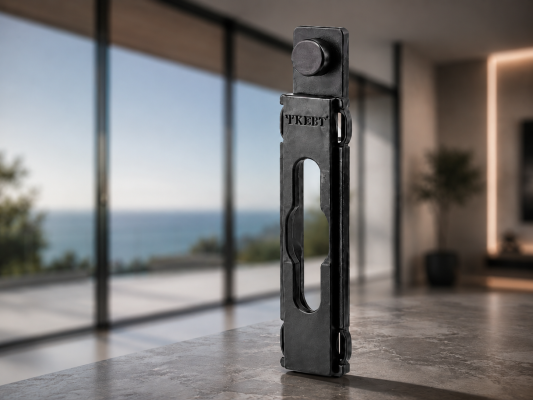
The striker is the counterpart that creates the locking and positioning point. In the drawing, the striker is named “Slim system striker”. It is a long, slim part with fixing holes and an oval adjustment slot. This shape is useful for installation because the technician can fine tune the contact point. For a large sliding door, that small adjustment can matter a lot.
Kerssenberg hardware in this area does not work alone. It works with the handle, locking body, bottom rollers, upper guide rollers, stainless steel tracks, and sealing gaskets. The door only becomes tight when all these parts meet at the correct position. If the rollers are smooth but the locking point is loose, the panel may still move slightly. If the gasket is good but the lock does not pull the panel into place, sealing will still be weaker.
This is why the edge lock head and striker should be seen as precision parts. They are small in size, but they help decide the final closing state. In a slim panoramic sliding door, the closed state matters more than the open state. That is the moment when the door must resist dust, draft, water splash, and panel vibration.
Technical details of the edge lock head
The product name is “Slim system edge lock head.” It is designed for the locking edge of a slim sliding system. Its main function is to receive the locking point and help hold the door panel when closed.
The drawing shows several useful dimensions. The visible width of the front part is about 18 mm. The inner body width is about 12 mm. The side projection shown in the drawing is about 16 mm. These figures show why the part is suitable for slim systems. It is narrow enough to fit a refined aluminium structure, while still giving the lock a defined contact point.
Kerssenberg hardware uses compact dimensions here because slim panoramic doors have limited space inside the frame and panel profile. A bulky locking part would not match the visual language of a slim door. It could also make installation harder inside a narrow aluminium section. The 18 mm front width and 12 mm inner body width help the part sit neatly inside the locking zone.
The side projection of about 16 mm is also important. It relates to how the lock head reaches the locking mechanism and creates contact. If this projection is not aligned well, the handle may feel heavy. The lock may also fail to engage smoothly. When alignment is correct, the user should feel a clear and stable closing action.
This part should be installed according to the system position. The height, depth, and fixing point need to match the lock body and striker. On large panels, the technician should also check panel plumb and roller height before final adjustment. A correct lock head cannot compensate for a badly levelled door.
Technical details of the striker
The product name is “Slim system striker.” Its main role is to provide the fixed point for locking and positioning. When the door is closed, the lock mechanism connects to this part and helps keep the panel in place.
The drawing shows a total length of about 97 mm. The total width is about 19 mm. The inner body width is about 15 mm. The side thickness shown is about 3 mm. On the body, there is an oval slot of about 8 mm by 44 mm. This slot is one of the most important details. It allows practical adjustment during installation.
Kerssenberg hardware uses this oval slot to give technicians a controlled correction range. Slim panoramic doors can be tall and heavy. The opening may also have small tolerance differences after construction. A fixed hole with no adjustment would make alignment harder. The long slot allows the striker position to be moved slightly until the lock engages correctly.
The 97 mm length helps the striker create a stable contact area. It is not just a tiny point screwed to the frame. It has enough body length to sit firmly and receive force from the lock. The width of about 19 mm also suits a slim system because it keeps the part narrow and discreet. From the side view, the 3 mm thickness shows a slim profile that can sit close to the aluminium surface.
For installation, the striker must be placed where the lock point naturally reaches it. If it is too high, too low, too deep, or too shallow, the user may feel resistance. The door may close, but the sealing line may not be consistent. Correct striker adjustment helps the panel settle into the intended position.
Why do these two parts affect door sealing so much?
A sliding door does not seal simply because it reaches the end of the track. It seals when the panel is held at the correct position with the correct pressure. The edge lock head and striker help control that final position. Without them working properly, the panel may stop slightly away from the gasket line. Even a small gap can affect comfort inside the house.
Kerssenberg hardware improves sealing by making the locking edge more stable. When the lock engages the striker, the panel is less likely to move back from the closed point. This gives the gasket a better chance to touch evenly. It also helps the brush gasket and EPDM gasket work as intended. The gasket cannot perform well if the panel keeps a loose or uneven closing line.
With slim panoramic doors, the technical gap is often tightly managed. In the Kögen 138 slim panoramic system, the technical gap is about 4 mm. This gap is part of the operating design. It does not mean the door is open or badly sealed. It means the door needs accurate hardware and gasket contact to close correctly while still sliding smoothly.
The edge lock head and striker also reduce local gaps near the locking side. This is often the most sensitive area. The middle of the panel may look aligned, but the locking edge can still shift under hand force or wind pressure. A secure locking point limits that movement. It also makes the door feel more finished when the user turns the handle.
In real use, better sealing means fewer unwanted drafts and less dust entering through the locking edge. It also supports better rain resistance when the whole system is designed and installed correctly. These parts are not the only reason a door seals well, but they are critical at the closing point.
How they work with gaskets, rollers, tracks, and the slim gap
Sealing performance comes from a group of details working together. The bottom rollers carry the glass and aluminium panel. The upper guide rollers help control movement at the head of the door. The stainless steel track gives the rollers a stable rolling surface. The gaskets create the contact line. The locking parts then hold the panel at the correct closing point.
Kerssenberg hardware is part of this full chain. If one link is wrong, the whole door can feel less tight. For example, a good striker cannot solve a dirty or uneven track. A strong lock head cannot fix a panel that is tilted because the rollers were not adjusted. In the same way, good rollers cannot create sealing pressure if the lock point does not engage.
For slim panoramic systems, the gasket arrangement is usually a combination of EPDM gasket and brush gasket. The EPDM gasket helps form a more elastic sealing contact. The brush gasket helps reduce dust and small airflow paths. These materials need contact. They cannot block air well if the panel remains away from the frame or meeting point.
The technical gap of about 4 mm must also be respected. If the gap is too tight, the door may rub and become heavy. If the gap is too wide, the gasket may not contact well. The edge lock head and striker help maintain the designed closing position within this narrow working range.
This is why adjustment should happen after the door panel is already running smoothly. The technician should check the track level, roller height, panel plumb, and gasket contact first. Then the locking position can be tuned. When these steps are done in the right order, the door can close firmly without becoming hard to use.
Where their role becomes most visible in real projects
The role of these two parts becomes clearer on large openings. A slim panoramic door can be used for wide living rooms, garden exits, balconies, and facade areas. In these positions, the door is often taller and wider than a normal window. A taller panel can amplify small alignment errors. A wider panel can carry more glass weight. Both cases demand a more reliable closing point.
Kerssenberg hardware is especially important when each panel is large. The Kögen 138 slim panoramic system can support panel height up to 3.8 m in suitable configurations. It can also support panel width up to 2000 mm per sash, based on correct design and load calculation. With panels of this scale, the locking edge must be stable. Otherwise, the panel may feel less secure when closed.
Glass choice also changes the demand on the whole system. A 12 mm single glass panel is different from a 24 mm insulated glass unit. The insulated glass unit is usually heavier, so roller selection becomes more important. The lock head and striker do not carry the glass load like rollers do. Their job is different. They keep the closing side controlled after the load has been carried by the rollers.
Wind exposure is another practical case. Doors facing a garden, balcony, or open frontage may receive stronger pressure. If the locking side is loose, the user may hear slight rattling or feel vibration. The edge lock head and striker help reduce that loose feeling. In a complete system, they work with wind rated structure, tracks, rollers, and gaskets.
They also matter for daily comfort. A door that closes with a clear lock point feels easier to trust. The user does not need to pull hard or repeat the locking action. The panel returns to the same position every time, which helps maintain stable gasket contact.
Common problems when the lock head or striker is not adjusted correctly
A slim door system needs accurate fitting. If the edge lock head and striker are misaligned, several problems can appear. The most common issue is a heavy handle. The user has to force the handle because the lock point is hitting the striker at the wrong position. This can make the door feel less premium.
Kerssenberg hardware should engage cleanly. If the striker is too high or too low, the lock may scrape before entering. If it is too far inward or outward, the panel may not be pulled into the correct sealing line. The door may look closed from far away, but the gasket contact can still be weak at the edge.
Another issue is a loose closing feel. The user closes the door, turns the handle, but the panel still moves slightly when pushed. This may happen when the lock head does not sit firmly with the striker. It can also happen if the fixing screws are not tight enough. Over time, repeated opening and closing may move a poorly fixed part.
A local gap near the lock side is also possible. The top part may be tight, while the lower part has a small opening. The opposite can also happen. This problem is not always caused by the lock parts alone. It may come from roller height, track level, or panel plumb. Still, the lock head and striker should always be checked during final commissioning.
Installers should avoid correcting everything through the striker only. The striker adjustment slot is helpful, but it is not a shortcut for poor door alignment. The door should first run straight and smoothly. Then the locking point can be adjusted for a clean and firm closing feel.
How to inspect the sealing effect after installation
After installation, the first check should be the sliding movement. The panel should move smoothly on the track and stop naturally near the closing point. If the panel is heavy before locking, the problem may not be the lock. It may come from roller adjustment, track cleanliness, or panel alignment.
Kerssenberg hardware should then be tested through the handle action. The handle should turn with a firm but comfortable feel. It should not require excessive force. It should also not feel empty or loose. A clean locking action shows that the lock head and striker are meeting at the correct point.
Next, inspect the locking edge from top to bottom. The line between the panel and the frame should look even. The gasket should not be crushed at one point and untouched at another. Uneven contact can reduce sealing and make the door harder to use. If the door uses EPDM and brush gasket together, both should sit in the designed contact zone.
A simple vibration check is also useful. After locking, apply light hand pressure to the panel. The panel should not shake loosely at the locking side. Some movement can exist in a large sliding system, but the locked edge should feel controlled. If the panel rattles, the striker position or fixing strength may need attention.
For projects exposed to rain and wind, inspection should be more careful. The installer should check drainage, track position, gasket continuity, and the lock point together. The lock parts support sealing, but they do not replace a complete system design. Good sealing depends on accurate installation from the bottom track to the locking edge.
Why synchronized slim hardware matters more than single parts
Many people judge a slim panoramic door by its frame size and glass view. Those details are visible. Hardware synchronization is less visible, but it shapes the daily experience. A door can look slim yet feel loose if the closing parts are not matched. A door can also use good glass but still allow drafts if the locking edge is unstable.
Kerssenberg hardware offers value because the parts are selected for a slim system. The edge lock head and striker follow compact dimensions. The lock head is about 18 mm wide at the front, with a 12 mm inner body. The striker is about 97 mm long and 19 mm wide, with an 8 mm by 44 mm oval adjustment slot. These are not oversized general parts. They are sized for narrow aluminium structures.
Synchronized hardware also reduces adjustment conflicts. The lock point, handle movement, striker position, and panel closing line must agree with each other. If a non matching part is used, one detail may fit while another becomes harder to align. This can make the handle heavy or the gasket contact uneven.
For a slim panoramic sliding door, the best result comes from a full system view. The designer should calculate panel size, glass type, roller load, track type, gasket contact, and locking hardware together. For example, 12 mm glass and 24 mm insulated glass can create different loads. Large panels may need stronger bottom rollers. Tall panels may need more careful guide control. The lock parts then complete the closing and sealing action.
This is why these small components should not be treated as minor accessories. They are part of the final sealing line. They help the door close repeatedly at the same position, which is important for long term comfort.
Practical selection notes for slim panoramic projects
When choosing lock parts for a slim panoramic sliding door, start with the actual door configuration. A 2 track 4 panel door has different movement and meeting points from a 3 track 6 panel or 4 track 8 panel layout. The locking edge must be planned before fabrication, not solved only at the site.
Kerssenberg hardware should be matched with the correct profile system and lock body. The product codes should also be checked before installation. For this set, the edge lock head refers to the slim system edge lock head. The striker refers to the slim system striker. Mixing similar looking parts can create small but serious alignment issues.
Panel size is the next factor. A slim panoramic panel may be designed up to 2000 mm wide per sash in the correct system. Height may reach up to 3.8 m in suitable conditions. These sizes need accurate site measurement and a straight opening. If the wall opening is not plumb, the lock edge will be harder to seal.
Glass choice should also be considered. The system may use 12 mm glass or 24 mm insulated glass, depending on project needs. The heavier option needs proper roller selection. Bottom roller options can include different load levels, such as 80 kg, 160 kg, 350 kg, or 400 kg per panel depending on configuration. The lock head and striker do not replace this load calculation. They support closing stability after the panel has been carried correctly.
Finally, installation should include final adjustment and testing. The door should be checked after all panels are in place. The lock should engage smoothly, the gasket should contact evenly, and the panel should not rattle at the locking edge.
Conclusion
The edge lock head and striker may look like small details, but they strongly affect the closed condition of a slim panoramic sliding door. They help the panel stop at the correct point, support lock engagement, and improve gasket contact. This makes the door feel tighter, more stable, and more reliable in daily use.
Kerssenberg hardware is especially relevant for large slim panoramic doors because these doors depend on accurate alignment. The edge lock head has a compact front width of about 18 mm and an inner body width of about 12 mm. The striker has a length of about 97 mm, a width of about 19 mm, and an oval adjustment slot of about 8 mm by 44 mm. These figures show that both parts are built for slim, precise locking areas.
For better sealing, the project should not focus on one part only. The lock head, striker, gasket, roller, track, glass, and opening accuracy must work together. Kerssenberg hardware completes the closing detail when the whole door has been designed correctly. When these parts are selected and installed well, the door can close more firmly and maintain a cleaner sealing line.