
Large sliding doors need more than a strong lower roller system. They also need stable guidance at the top. This becomes more important when the door leaf is tall, wide, and fitted with large glass panels. A slim panoramic sliding door often uses a narrow 28 mm sash, large glass surfaces, and long sliding tracks. These details create a clean architectural look, but they also require accurate movement control.
When the door is pulled by hand, the pulling force is rarely perfectly straight. A small side force can create movement at the top of the sash. On a small door, this movement may not be easy to notice. On a tall door, it can become vibration, shaking, or light knocking inside the upper track. That is where Kerssenberg hardware becomes important.
The upper guide roller does not carry the main weight of the door. The load is mainly supported by the lower roller system. Its main role is to guide the top of the sash and keep the sliding direction stable. When it works together with the lower rollers, stainless steel tracks, gaskets, and locking points, the whole door feels firmer during operation.
For Kögen slim panoramic systems, this detail is especially useful in large openings. The door can be made up to about 3.8 m high and 2000 mm wide per sash. Glass options may include 12 mm single glass or 24 mm insulated glass. With these sizes, upper guidance is not a small detail. It is part of the door’s stability.
What is Kerssenberg hardware in a slim panoramic sliding door?
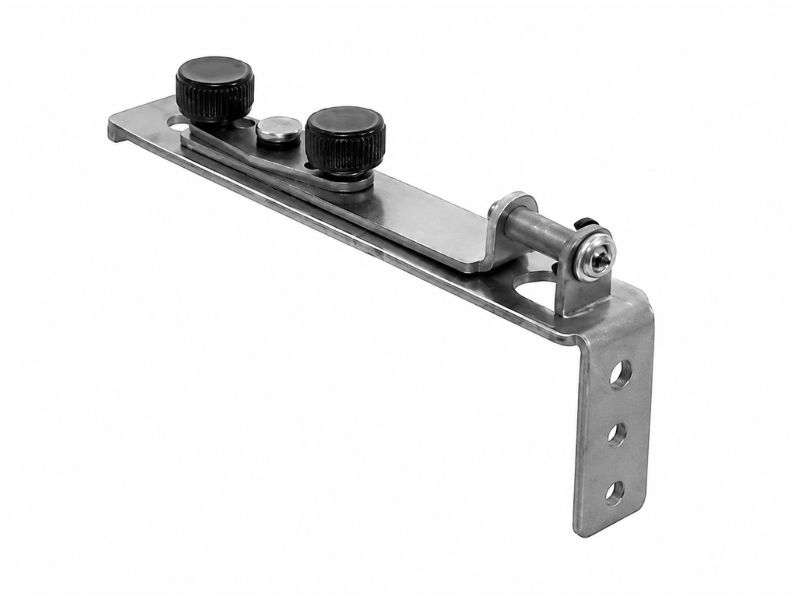
The upper guide roller is installed near the top of the sliding sash. It works with the upper track to control the movement direction of the door. Based on the drawing, the part includes a long metal fixing body, an upright fixing plate, screw holes, and upper guide wheels. The drawing also shows a technical height reference of about 5 mm at one end, which reminds installers that positioning accuracy matters.
In this position, Kerssenberg hardware works as a guide, not as the main load carrier. This is an important difference. Many people think rollers only make the door slide. In a slim panoramic sliding system, each roller has a different function. The lower rollers support the sash weight. The upper guide roller keeps the sash running in the correct line.
The part is placed where vibration often starts, which is the upper area of the moving sash. When the door is tall, the top can move more than the bottom. The lower rollers sit on the track and carry the weight. However, the upper section still needs control. Without proper guidance, the sash may lean slightly, move sideways, or create small impact sounds.
The upper guide roller helps reduce these movements. It keeps the top of the sash aligned with the upper track. This helps the door move more smoothly across the opening. It also reduces the chance of the sash touching the track unevenly during use.
This is why the component should be seen as part of the full sliding mechanism. It should not be treated as an optional small fitting. For a large slim panoramic door, the upper guide roller helps the system feel stable, precise, and more controlled.
Technical specifications related to the slim panoramic door system
A slim panoramic sliding door must be evaluated as a complete system. The guide roller is important, but it works together with the frame, sash, glass, tracks, gaskets, and lower rollers. For the Kögen slim panoramic system, the sash is designed with a 28 mm visible slim profile. This slim design helps reduce visual heaviness and gives the door a wider glass view.
The aluminium material is 6063 T5. This is used for the frame and sash system. The surface finish can be pearl grey powder coating, depending on the selected product version. The system can support large door sizes. The maximum height can reach about 3.8 m. The maximum sash width can reach about 2000 mm per leaf. These figures show why movement control is important.
Glass options include 12 mm single glass and 24 mm insulated glass. The final choice depends on sound reduction, thermal comfort, building position, and total sash weight. A 24 mm insulated glass unit is heavier than 12 mm single glass. This affects roller selection and installation accuracy.
The system can be configured with 2 tracks, 3 tracks, or 4 tracks. Common layouts include 2 panels, 3 panels, 4 panels, 6 panels, or 8 panels. These layouts are often used for living rooms, garden openings, balconies, villas, and large façades.
The lower roller options can be selected by load. Available references include 80 kg per sash, 160 kg per sash, 350 kg per sash, and 400 kg per sash. Stainless steel tracks of about 5 mm are used at the top and bottom. EPDM gaskets and wool pile gaskets help improve sealing. In this full setup, the upper guide roller supports stable sliding and helps reduce vibration at the top of the moving sash.
Why Kerssenberg hardware matters for large slim panoramic doors
Large slim panoramic doors have a different movement behavior from small sliding doors. A tall sash has more surface area and more leverage. When the user pulls the handle, the force travels through the sash. If the pull is slightly angled, the top of the sash can move sideways. This movement may be small, but it affects the feeling of the door.
The benefit of Kerssenberg hardware is not about carrying more weight. Its value is in controlling movement. It helps the sash stay in line with the upper track. When the top is guided properly, the lower rollers can run more consistently on the lower track. The whole door feels more balanced.
This matters most when the door is close to its large size limits. A sash height of 3 m, 3.5 m, or near 3.8 m needs better control than a small window door. The higher the sash, the easier it is to feel shaking at the top. The same principle applies to wide sashes. A door leaf near 2000 mm wide has more glass area and more inertia during movement.
Inertia appears when the user opens or closes the door quickly. The sash does not stop immediately. If the guidance is weak, the top may sway at the end of the movement. This can create a loose feeling. It can also cause light knocking between the sash and the track area.
The upper guide roller helps reduce this issue. It supports the sash at the upper section and limits side movement. It also helps the door run along a more predictable path. For users, this creates a more solid feeling when opening and closing the door.
How Kerssenberg hardware controls vibration during sliding
Vibration control starts with direction control. When a sliding sash moves, it should follow the track line as closely as possible. Any side movement can create shaking, friction, or impact noise. On a large slim panoramic door, even a small movement can be visible because the glass area is large.
Kerssenberg hardware helps limit this side movement at the top of the sash. The upper guide wheels work inside the upper guide area. They help keep the sash from moving too far to the left or right. This is especially useful when the door is pulled quickly or from an uneven angle.
The upper part of the sash is often the most sensitive area. The lower part is held by the weight and the lower rollers. The upper part does not have the same load pressure. It can move more easily if not guided well. The upper guide roller reduces this free movement.
This also helps reduce impact noise. If the sash sways inside the upper track, it may touch the track wall or frame area. The sound may not be loud, but it can reduce the premium feeling of the door. With better upper guidance, the sash moves more steadily. The door feels quieter and more controlled.
Another benefit is improved stability near the end of the sliding stroke. When the sash reaches the closing position, it may slow down or stop suddenly. If the top is not guided, it can shake at the final moment. The guide roller helps keep the top aligned, so the closing action feels firmer.
This is not a single component solution. The final result still depends on track straightness, lower roller load, glass weight, and installation quality. However, the upper guide roller is one of the key parts that keeps vibration under control.
Why tall and wide glass sashes need upper guide support
Slim panoramic sliding doors are often chosen for wide views. They are used to connect living rooms with gardens, balconies, pools, or outdoor terraces. These openings often need large glass panels. Large glass panels create a strong visual effect, but they also increase technical demands.
A sash with 12 mm glass already has notable weight. A sash with 24 mm insulated glass is heavier. When the sash becomes heavier, the lower roller system must be selected correctly. But weight is not the only issue. The height and width of the sash also affect movement stability.
A tall sash behaves like a vertical panel. If the bottom is stable but the top is loose, the door can feel unstable. This is why upper guidance is important. The upper guide roller controls the area where shaking is easiest to feel. It supports a more balanced movement from top to bottom.
A wide sash also needs control. When a 2000 mm wide panel moves, it has more inertia. If the user pulls it quickly, the sash can continue moving with momentum. This momentum can create side movement, especially if the pulling force is not straight. The upper guide roller helps keep this movement within the correct path.
This is important for multi track systems too. A 2 track, 3 track, or 4 track layout may include several large panels. The panels need to slide past each other without feeling loose. In layouts such as 3 panels, 6 panels, or 8 panels, stable guidance helps keep each sash moving cleanly.
For high end residential projects, the feeling of the door matters. Users do not only look at the profile size or glass area. They also judge the door by touch, sound, and movement. Upper guide support helps improve that daily experience.
Kerssenberg hardware and lower rollers: what is the difference?
The upper guide roller and lower rollers should not be confused. They work together, but they have different jobs. The lower rollers carry the main sash weight. They decide whether the door can move under the correct load. The upper guide roller controls the direction of movement at the top.
For a slim panoramic system, lower rollers may be selected according to sash weight. Lighter sashes can use lower roller options such as 80 kg per sash or 160 kg per sash. Heavier sashes may require stainless steel roller options rated at 350 kg per sash or 400 kg per sash. The right selection depends on sash size, glass type, and total weight.
The upper guide roller does not replace these lower rollers. It should not be used to compensate for an undersized lower roller. If the lower roller is not suitable, the door can still feel heavy, unstable, or hard to move. The upper guide roller only performs well when the bottom support is correctly designed.
For that reason, Kerssenberg hardware should be selected as part of a complete accessory set. The door also needs stainless steel tracks, locking points, side locking parts, handles, gaskets, and proper alignment. Each part has its own role. When they are matched correctly, the system works better.
The difference can be explained simply. Lower rollers carry the weight. Upper guide rollers control the path. One gives support. The other gives direction. Both are needed for a large sliding door.
This distinction is useful for customers. It helps them understand why a door can have strong lower rollers but still need guide control at the top. A heavy glass door needs strength, but it also needs accuracy. Without accuracy, the door may still vibrate during use.
Reading the upper guide roller drawing
The drawing shows a compact but functional component. It includes a long horizontal body and an upright fixing plate at one end. The fixing plate has several screw holes. These holes allow the component to be secured to the sash structure. A stable connection is necessary because the part must guide the moving sash repeatedly.
The upper area includes guide wheels. These wheels are placed above the main body. Their position allows them to work with the upper guide track. When the sash moves, these wheels help keep the top of the sash aligned. They also help reduce direct rubbing between hard surfaces.
The drawing also shows a screw and adjustment area. This suggests that accurate fitting is required during installation. The component must be placed at the correct height and position. If it is too loose, the guide effect may be weak. If it is too tight, the sash may create friction or noise.
A small 5 mm reference is visible in the drawing. This should be treated as an important installation reference. It shows that the clearance around the guide area is not random. Small clearances affect how the guide roller contacts the track. A small error may reduce the anti vibration effect.
It is also clear that this component is designed for control rather than decoration. It is hidden in the working part of the door system. The user may not see it during daily use. However, they will feel its effect when the door moves.
This is common in high performance sliding systems. The visible profile may look minimal, but the hidden details decide how stable the door feels.
Installation notes for Kerssenberg hardware in slim panoramic doors
Correct installation is essential. Even a good guide roller cannot solve poor alignment. Before installing the door, the opening should be checked carefully. The upper and lower tracks must be straight. The frame should not be twisted. The floor and head track area should also be prepared correctly.
The lower track is especially important. If the lower track is uneven, the sash may rise and drop during movement. This can create vibration, noise, or a heavy sliding feeling. The upper guide roller may reduce side movement, but it cannot fix a bad lower track. Both upper and lower tracks need to work together.
The lower roller selection must match the real sash weight. This includes aluminium weight, glass weight, and accessory weight. For a smaller sash, a lighter roller capacity may be enough. For large glass panels, a 350 kg or 400 kg per sash lower roller option may be needed. The final choice should be made according to the actual design.
The upper guide roller should also be positioned accurately. The fixing screws must be secure. The guide wheels must meet the upper guide area correctly. The clearance should not be too large or too tight. After installation, the sash should be tested across its full travel distance.
The installer should check several points. The door should slide smoothly. The top should not shake. The sash should not rub against the track. The closing point should feel firm. The locking point should align correctly. The gasket compression should be even.
These checks are not small steps. They decide whether the door feels premium after installation. A slim panoramic door has large glass and minimal visible profile. Because of that, installation accuracy becomes even more important.
Does the upper guide roller make the door slide lighter?
The upper guide roller does not directly make the door lighter. Sliding lightness mainly comes from the lower rollers, track quality, sash weight, and installation accuracy. If the lower rollers are undersized, the door can still feel heavy. If the track is not straight, the door can still feel rough.
However, the upper guide roller can improve the feeling of movement. It keeps the sash aligned and reduces side shaking. When the sash moves in a clean line, there is less unwanted contact. This can make the door feel smoother in daily use.
A door that vibrates often feels heavier than it really is. The user may pull harder because the sash feels unstable. Once the top is guided well, the movement feels more predictable. The user can control the sash with less effort and more confidence.
This is why the upper guide roller should not be judged only by load capacity. Its real value is movement quality. It helps improve the feeling of precision. It also helps reduce loose movement at the top of the sash.
For large doors, this feeling is important. A slim panoramic door is often installed in main living spaces. It may be used many times each day. Users expect it to look light and move quietly. They also expect it to feel safe and stable.
The best result comes from a balanced system. Use the right lower roller capacity. Keep the stainless steel tracks straight. Install the upper guide roller accurately. Check the locking and sealing points. When these details work together, the door can move with a smoother and firmer feel.
Suitable applications for slim panoramic doors with upper guide rollers
Slim panoramic doors with upper guide rollers are suitable for large openings. They are often used in modern homes, villas, townhouses, and garden houses. The system is especially useful where the owner wants a wide view and stable sliding movement.
One common application is the living room opening. Many homes use large sliding doors to connect the indoor space with a garden or terrace. In this position, the door is usually tall and wide. It may also be opened and closed many times. Upper guide support helps the sash remain stable during repeated use.
Another suitable area is a villa façade. Large glass openings are common in villas. These openings need a slim visual effect, but they must also resist shaking. A stable guide system helps maintain a better operating feel.
Balcony and poolside openings can also benefit from upper guide rollers. These areas may receive wind pressure. Wind can act on the large glass surface and create side movement. The upper guide roller helps keep the sash inside the correct track line.
Tall openings in double height living rooms also need attention. When a door reaches 3.5 m or near 3.8 m, the top of the sash becomes more sensitive to movement. A good upper guide system helps control this area.
Multi panel doors are another good use case. Systems with 3 tracks, 4 tracks, 6 panels, or 8 panels have longer sliding paths. Each sash needs to run neatly. Stable guidance helps reduce shaking between panels and supports better daily operation.
Conclusion: why this detail matters in a slim panoramic sliding door
A slim panoramic sliding door is not only about narrow profiles and large glass. It is also about stable movement. When the sash is tall, wide, and heavy, small details become important. The upper guide roller is one of those details.
When Kerssenberg hardware is selected and installed correctly, it helps the top of the sash move in a stable line. It reduces side movement, limits vibration, and improves the feeling of control. It also works with the lower rollers to create a more balanced sliding action.
This does not mean the upper guide roller carries the whole door. The main load still belongs to the lower roller system. For that reason, the lower rollers must be selected according to actual sash weight. The track must be straight. The frame must be installed accurately. The glass type must be considered. The sealing and locking parts must also be aligned.
For Kögen slim panoramic systems, these details are even more important because the door can be large. The system may reach about 3.8 m high and 2000 mm wide per sash. It can use 12 mm single glass or 24 mm insulated glass. It can also be designed with 2 track, 3 track, or 4 track layouts.
For customers, the final result is simple. The door should look clean, slide smoothly, and feel steady in the hand. A good upper guide roller helps make that experience possible. It is a hidden part, but it has a clear effect on comfort, stability, and long term operation.